

Course Introduction
Spiritual awakening can feel meaningful, expansive and deeply important. It can also be confusing, destabilising or frightening. My spiritual awakening course, Spiritual Awakening: Belonging in the Process, was created for people who want a grounded, compassionate way to explore spiritual emergence, spiritual crisis and profound inner change without having to immediately explain, control or pathologise what is happening.
You may have experienced a sudden shift in identity, a powerful meditation experience, a sense of oneness, unusual bodily sensations, intense meaning or meaninglessness, a changed relationship with death, or the feeling that the person you used to be no longer quite fits.
Perhaps you are wondering whether what you are experiencing is spiritual, psychological, both, or something you simply do not yet have words for.
This course does not try to answer that question for you.
Instead, it offers practices for becoming more able to stay present with uncertainty, explore your experience with curiosity, and continue participating in ordinary life while you make sense of what is happening.
What is Spiritual Awakening?

There is no single psychological or medical definition of spiritual awakening. People use the term to describe a wide range of experiences, including profound changes in identity, values, meaning, perception, connectedness or spirituality.
Research into so-called non-ordinary experiences includes experiences such as feelings of oneness, unusual perceptions and hearing voices. A 2024 systematic review concluded that these experiences can be personally meaningful, but can also produce distress, uncertainty and difficulties in functioning. The research is heterogeneous, so no single interpretation fits every experience.
That matters because it is easy to swing between two extremes.
One is to assume that every unusual experience is evidence that something is psychologically wrong. The other is to assume that every unusual experience is evidence of spiritual transformation or special insight.
A more grounded position is to remain curious about the meaning of an experience while also paying attention to distress, functioning, sleep, relationships and safety.
That is the spirit behind this spiritual awakening course.
When Spiritual Awakening Becomes a Spiritual Crisis
A spiritual awakening isn’t necessarily comfortable.
Sometimes your previous understanding of yourself, your relationships or reality changes faster than you can integrate it. You may feel as though an old identity is dissolving while a new one has not yet formed.
That can create anxiety.
You might become preoccupied with questions about consciousness, reality, death, God, purpose or the nature of the self. You might feel detached from ordinary life or unusually sensitive to your surroundings. Intense emotions, strange bodily sensations or experiences that are difficult to describe may also occur.
Some people call a period like this a ‘spiritual crisis’ or ‘spiritual emergency’.
This is why I don’t think it is helpful simply to tell someone, “You’re awakening, so everything you’re experiencing is fine.”
Nor is it necessarily helpful to say, “This is pathological, so stop exploring it”.
Sometimes the most useful place to begin is:
Curiosity about what is happening, how is it affecting you, and how can you feel safe and grounded while you explore and hold lightly what it might mean?
Who Might Benefit From this Spiritual Awakening Course?
You may find my spiritual awakening course useful if you are curious about your experience but you are unconvinced that you want therapy.
It may suit you if you are moving through a period of profound personal change, exploring spirituality or meditation, recovering from an overwhelming spiritual experience, or trying to understand why life suddenly feels different.
You might recognise yourself in questions such as:
- Why don’t I feel like the same person anymore?
- Why does meditation sometimes leave me feeling unsettled?
- Why am I questioning beliefs I previously took for granted?
- How can I live normally while something profound is happening inside me?
- How can I stop needing to understand everything immediately?
- How can I trust myself without assuming that every feeling or intuition is necessarily true?
You may also appreciate my course if you want practical exercises rather than another collection of theories.
You will encounter guided meditations, reflections and simple practices that you can return to repeatedly.
What Does “Belonging in the Process” Mean?

The central idea of the spiritual awakening course is simple:
You do not have to completely understand your experience before you can gain the sense that you belong within it.
During periods of uncertainty, the mind naturally tries to predict, explain and control. This can be useful, but anxiety can become more persistent when uncertainty itself starts to feel threatening.
Research increasingly highlights intolerance of uncertainty and avoidance as important processes in anxiety. Exposure therapy, for example, suggests that therapeutic learning can involve discovering that feared experiences can be approached without the feared outcome necessarily occurring, rather than relying only on getting rid of anxiety first.
I sometimes describe the two tendencies in very simple terms: ‘Predicty‘ and ‘Belongy‘.
Predicty is the part of you that wants to know what happens next.
Belongy represents the capacity to remain connected to experience before you have worked everything out.
These are metaphors. Their purpose is to make a complicated process easier to notice.
From Prediction to Belonging
Imagine that you experience a thought that feels frightening.
Predicty may immediately ask:
“What does this mean?”
“Why is this happening?”
“What if something is wrong?”
“How do I make it stop?”
Occasionally those questions can be useful.
At other times, repeatedly asking them can become another way of trying to escape uncertainty.
Belonging offers another possibility.
You notice the thought
…And the sensation in your body.
You allow yourself to breathe,
You do not have to decide what the experience means in that moment.
This doesn’t mean becoming passive or ignoring genuine danger. It means experimenting with whether you can remain present without treating every moment of uncertainty as a problem that must be solved immediately.
The spiritual awakening course uses meditation and reflection to practise this kind of relationship with experience.
Why Meditation and Repeated Practice may Help

The course includes guided meditations because understanding an idea intellectually is different from becoming familiar with it through experience.
Mindfulness meditation research suggests that practices involving attention, present-moment awareness and a less reactive relationship with experience can alter the reactivity of the brain.
Self-compassion is another relevant theme. Self-compassion-focused interventions and play a role in reducing anxiety symptoms.
That fits with an important principle of this spiritual awakening course: you don’t have to become better at spiritual awakening before you are allowed to look after yourself.
What you can Learn From the Spiritual Awakening Course
The course is designed around several practical capacities.
It can help you learn ways of grounding yourself when your inner experience feels intense.
It han help you relate to uncertainty without automatically trying to eliminate it.
You can explore the difference between an experience and the interpretation you give it.
It can also give you opportunities to develop more trust in your own capacity to notice, reflect and choose.
Meaning can be explored without assuming that you must immediately find a final explanation.
You can practise remaining connected to ordinary relationships, routines and responsibilities while also giving your inner experience appropriate attention.
The intention is not to make your spiritual experience more dramatic.
It is to help you become more capable of meeting whatever arises.
What the Spiritual Awakening Course Cannot Provide
The spiritual awakening course is not a replacement for therapy.
I won’t have my therapist hat on within this course. I will be your meditation guide.
The course does not assess whether an experience is a spiritual awakening, a spiritual crisis, a psychiatric condition, a trauma response, a response to substances, or something else.
If you are experiencing serious difficulty functioning, or concerns about your own or someone else’s safety, psychiatric or psychological assessment is important something which I cannot provide in this course, or elsewhere.
In other words, this course is designed to complement appropriate support, where it is needed, not to substitute for it.
When you Might Need More Than a Spiritual Awakening Course
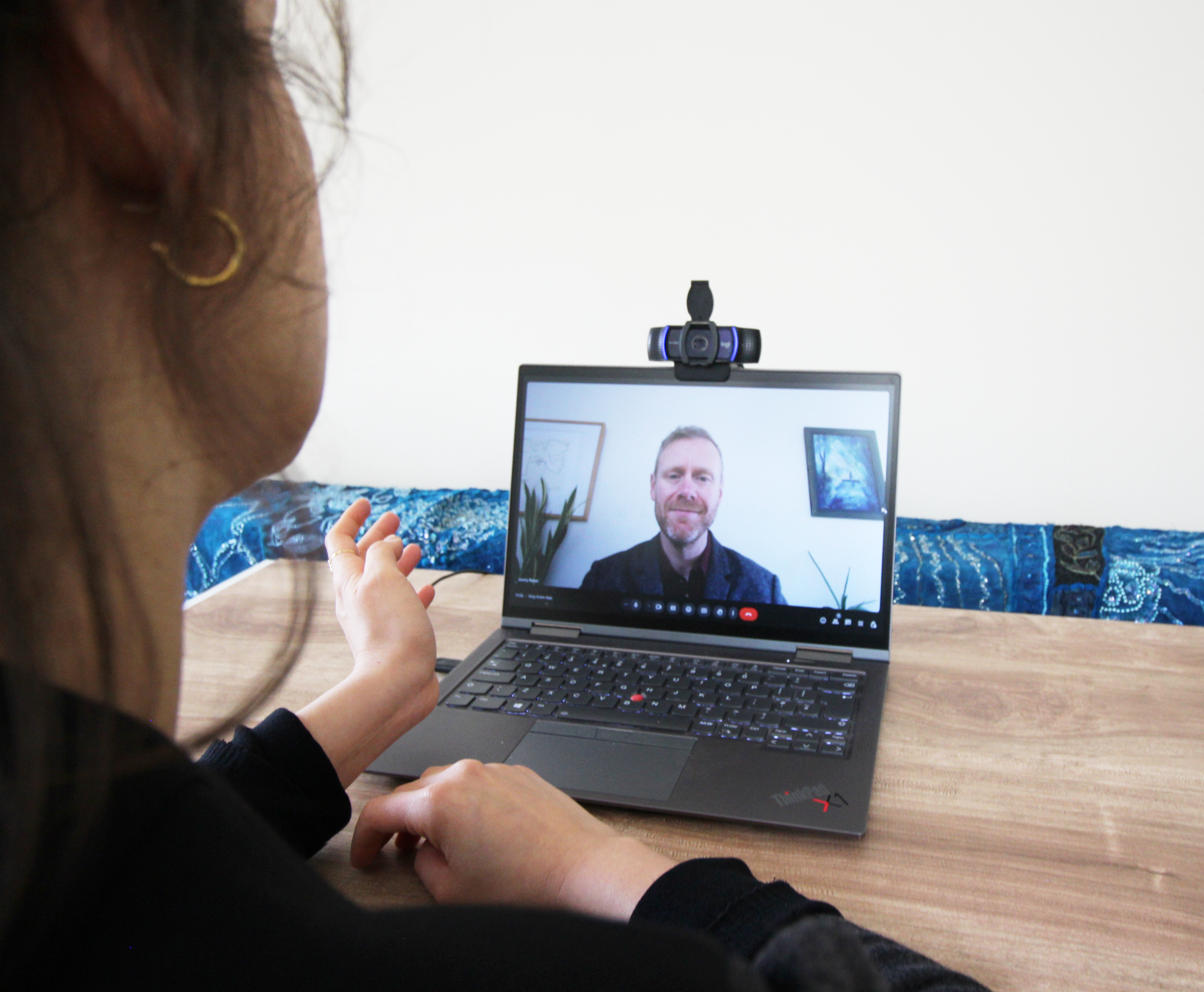
Sometimes self-guided practices are enough.
At other times, the experience is too personal, complex or emotionally charged to work with effectively on your own.
You may need help if your spiritual awakening is unmanageably connected with panic, death anxiety, intrusive thoughts, avoidance, relationship difficulties, longstanding emotional patterns or a profound crisis of identity and meaning.
This is where Online Integrative Hypno-Therapy can offer something different.
A course gives you a framework and practices that you work through yourself.
Therapy gives you a relationship in which someone can listen closely to your particular experience and respond to your needs.
How Online Integrative Hypno-Therapy can Help
My approach combines several therapeutic perspectives rather than assuming that one model will fit everyone.
Hypno-therapy
Hypnosis can provide a focused state of attention in which you can slow things down, notice internal experience and explore different ways of responding to thoughts, emotions and sensations.
A 2019 meta-analysis found that hypnosis was associated with reductions in anxiety, with larger effects when hypnosis was combined with other psychological interventions.
That supports using hypno-therapy as one tool within an integrated approach rather than presenting hypnosis as a standalone treatment.
Exposure Therapy
When anxiety is maintained by avoidance, checking or attempts to control uncertainty, exposure-based work can sometimes help you approach experiences differently.
Modern exposure approaches increasingly focus on new learning rather than simply waiting for anxiety to disappear. This can be relevant to existential anxiety, death anxiety and spiritual experiences when the difficulty lies partly in what you fear an experience might mean or what you feel compelled to do to make it go away.
Exposure is always tailored and carefully paced.
The purpose is not to overwhelm you.
Person-centred Therapy and the Therapeutic Alliance
A person-centred approach places importance on empathy, authenticity and taking your experience seriously without assuming that the therapist already knows what it means.
That is particularly relevant when you are questioning your identity or worldview.
The therapeutic alliance adds something further: the quality of the working relationship itself. A 2023 systematic review and meta-analysis of teletherapy (online therapy) found equal effectiveness between teletherapy and in-person therapy, suggesting that the relationship remains relevant when therapy takes place online.
The relationship can provide a place where you don’t have to perform certainty.
Existential Therapy
Existential therapy can help when the central questions concern mortality, freedom, meaning, isolation, responsibility, identity or what makes life worth living.
The aim isn’t necessarily to give you an answer.
It can be to help you develop a more workable and authentic relationship with questions that may never have one final answer.
Transpersonal Therapy
Transpersonal approaches are explicitly interested in experiences involving spirituality, transcendence and altered or nonordinary states.
This can provide a useful language when conventional psychological descriptions don’t seem to capture your experience.
I use transpersonal ideas as a framework for respectful exploration, not as proof of what a spiritual experience objectively is.
Schema therapy
Schema therapy can be relevant when spiritual or existential anxiety activates older patterns around abandonment, defectiveness, emotional deprivation, isolation or the need to meet demanding internal standards.
It can help distinguish the immediate experience of life and yourself from longstanding ways of interpreting yourself and other people. For some going through spiritual awakening this feels relevant in relation to both past-life and current-life experiences.
The research is promising so far, albeit in its preliminary years. A 2021 systematic review found beneficial effects for anxiety, OCD and PTSD among six studies.
Integrating Spirituality into Therapy
There is also evidence that therapy can benefit from taking a client’s spiritual or religious framework seriously when it is important to them.
Psychotherapy adapted to clients’ religious or spiritual beliefs and values has shown large improvements to psychological functioning and spiritual wellbeing compared to no treatment.
This does not mean that spirituality should automatically be incorporated into everyone’s therapy, as it is only applicable where clients already possess spiritual and religious beliefs and values.
This means that, when spirituality is central to your experience, it can be relevant to have space to talk about it.
Spiritual Awakening Course or Therapy: Which do you Need?
You don’t necessarily have to choose one forever.
The spiritual awakening course may be enough when you are relatively stable, curious and able to engage with the material safely by yourself.
Therapy may be more appropriate when you need personalised support, a therapeutic relationship, help with anxiety or avoidance, or assistance integrating experiences that are interfering with everyday life.
Some people may use the course first and seek therapy later.
Others may already be in therapy and use the course as an additional source of meditation and reflection.
The important difference is that the spiritual awakening course offers structured self-guided exploration, whereas therapy offers bespoke, targeted and relational work.
Staying Connected to Ordinary Life

One of the themes running throughout the spiritual awakening course is that spiritual exploration does not have to mean withdrawing from ordinary life.
Eating, sleeping, working, exercising, spending time with people you trust and maintaining familiar routines can all provide useful points of contact with everyday reality.
You can take your experience seriously without allowing it to consume your entire identity.
You can remain curious without believing every interpretation that occurs to you.
Spiritual exploration can coexist with relationships, responsibilities and practical life.
That balance can be particularly important when an experience feels enormous.
You Don’t Have to Figure Everything out at Once
A spiritual awakening can raise questions that are much bigger than your current ability to answer them.
That doesn’t necessarily mean you are failing.
It may simply mean that you are encountering something you have not yet learned how to hold.
The invitation of Spiritual Awakening: Belonging in the Process is therefore not:
“Here is what your awakening means.”
It is closer to:
“Here are some ways of being with what is happening, while you discover what it means for you.”
For some people, that may be enough.
For others, a deeper therapeutic relationship may be the next step.
My spiritual awakening course can give you a structured place to practise meditation, reflection, grounding, uncertainty tolerance and belonging. If what you are experiencing needs something more personal, my Online Integrative Hypno-Therapy provides a confidential, collaborative space to explore the emotional, psychological, existential and spiritual dimensions of your experience in a way that is shaped around you.
You don’t have to decide immediately what your experience means.
You can begin by finding a way to belong in the process.
FAQs
A spiritual awakening course is a structured educational and experiential programme designed to help you explore spiritual or transformative experiences through reflection, meditation and practical exercises. This particular course focuses on belonging, emotional security, uncertainty, self-trust, meaning and integration.
Not necessarily. Some people experience spiritual awakening as positive and manageable, while others experience periods of confusion, fear, identity disruption or loss of meaning that they describe as spiritual crisis. Non-ordinary experiences can have very different psychological effects depending on the person and circumstances.
No. The course is therapeutically informed, but it is not therapy. I will be your meditation guide rather than your therapist in this context. Professional psychological or psychiatric support may be appropriate when experiences are causing significant distress, significantly affecting functioning or creating concerns about safety.
Therapy may be more appropriate when you need a tailored approach, focused work with anxiety or avoidance, or a therapeutic relationship in which your specific experience can be explored and responded to over time. My integrative approach can draw on hypno-therapy, exposure therapy, person-centred therapy, existential therapy, transpersonal therapy, schema therapy and the therapeutic alliance according to what is relevant to your needs.