

Why Feeling That you Belong May Matter More Than Finding all the Answers
What if part of what makes existential anxiety so difficult isn’t simply what you’re thinking about, but the feeling that you no longer know where you belong?
This can happen during an existential crisis, a spiritual crisis, a period of profound personal change, or simply a time when the identity and assumptions that previously gave life a sense of stability no longer seem to work.
You might find yourself asking:
- Who am I now?
- What is the point of my life?
- What can I trust?
- What happens when I die?
- What if nothing means what I thought it meant?
- Why don’t I feel like myself anymore?
- Where do I belong when I don’t even know who I am?
Sometimes the instinctive response is to try to think your way out of uncertainty.
You search, analyse, look for explanations. You try to understand what is happening to you.
And sometimes that helps.
But sometimes the search for certainty becomes part of the problem.
Psychological research increasingly highlights the importance of how we respond to uncertainty, avoidance and perceived threat in anxiety. Rather than anxiety simply being a response to a particular danger, some contemporary models understand anxiety in terms of difficulties learning and functioning under uncertainty (Brown et al., 2023).
So perhaps there is another possibility.
Instead of asking:
“How can I make everything certain enough to feel safe?”
we might sometimes ask:
“Can I learn to feel that I belong, even when I don’t know?”
Meet Predicty and Belongy
To explore this, I’d like to introduce you to two imaginary characters. Yes this is child-like, which is precisely what can help to greet this process with a light heart.

Prediting
Let’s call the first one Predicty.
Predicty is the part of you that likes things to be predictable.
He wants to know what is happening, what will happen next, who you are, what other people are doing, whether something is safe, and what you should do about it.
Predicty isn’t necessarily your enemy.
In fact, prediction is an important part of how human beings navigate the world.
Your brain constantly uses previous experience to anticipate what might happen next. This allows you to conserve energy, make decisions and respond rapidly to potential threats.
The difficulty comes when prediction becomes something you feel you must do in order to be okay.
When uncertainty feels intolerable, you may find yourself checking, analysing, researching, rehearsing, avoiding, reassuring yourself or trying to control your internal experience.
This can be particularly powerful during existential or spiritual crises.
If your previous understanding of yourself and the world has changed, Predicty may work overtime trying to restore the old sense of certainty.
And this is where our second character comes in.
Belonging
Let’s call him Belongy.
Belongy represents something quite different.
He doesn’t need everything to be explained before you can experience yourself as part of life.
Belongy is associated with allowing yourself to experience rather than constantly analysing the experience.
You may already know something like this.
Perhaps you’ve experienced it while:
- playing sport
- walking in nature
- listening to music
- becoming absorbed in a film or book
- laughing with friends
- spending time with children
- creating something
- meditating
- becoming absorbed in meaningful work
For a while, you aren’t trying to work everything out.
You are simply there.
You are participating in experience rather than standing outside it and analysing it.
Belonging Doesn’t Mean Everything is Okay
It’s important to make a distinction here.
Belonging doesn’t mean pretending that everything is fine.
It doesn’t mean suppressing fear, ignoring difficult circumstances, adopting positive thinking or convincing yourself that you have nothing to worry about.
And it doesn’t mean deciding that unusual spiritual experiences are necessarily evidence of something supernatural.
Instead, belonging can be understood as a way of relating to experience.
You might feel anxious and still belong.
You might feel confused and still belong,
…or you might not know who you are and still belong.
You might experience uncertainty and still belong.
You might even experience a profound existential crisis and discover that there is a way of being with that experience without immediately having to solve it.
This is particularly relevant because social connection and perceived belonging are consistently associated with better mental-health outcomes. Reviews of longitudinal research suggest that social connectedness and support can protect against psychological difficulties, while loneliness and social isolation are associated with poorer outcomes (Holt-Lunstad J., 2022; Leigh-Hunt et al., 2017).
But belonging doesn’t only have to mean belonging to other people.
There can also be a more immediate sense of belonging to your own experience.
A sense of:
“I am here.”
“This experience is happening.”
“I don’t have to completely understand it in order to be present with it.”
Why Uncertainty can Make Predicty Work Harder

Imagine that you suddenly experience yourself differently.
Perhaps you’ve been through a spiritual awakening.
Perhaps a relationship has ended.
Maybe you’ve reached midlife and the identity you built earlier in life no longer feels convincing.
Perhaps you’ve encountered death, illness, loss, psychedelics, meditation or another experience that has radically altered your perspective.
Or perhaps there is no obvious event at all.
You simply realise:
“I don’t know who I am anymore.”
Predicty may interpret this as a problem that needs solving.
So it searches for answers.
It tries to reconstruct your identity.
It attempts to predict what will happen
…and looks for explanations.
It may even become frightened by the fact that you cannot find an explanation.
This can create a loop:
Uncertainty → anxiety → prediction and control → temporary relief → renewed uncertainty → more prediction and control.
This is one reason why reassurance and intellectual understanding can sometimes provide relief without fundamentally changing the relationship you have with uncertainty.
Contemporary approaches to anxiety increasingly emphasise the role of uncertainty and avoidance. Anxiety can be understood partly as a difficulty with learning and decision-making under uncertainty.
This helps explain why simply acquiring more information doesn’t always resolve existential anxiety.
Sometimes the problem isn’t that you don’t have enough information.
Sometimes it is that your nervous system has learned that not knowing is dangerous.
What Happens When you Stop Fighting the Experience?
This doesn’t mean giving up.
It means experimenting with a different response.
Imagine feeling uncertainty and noticing:
“There is uncertainty here.”
Rather than:
“I need to get rid of this uncertainty.”
Imagine feeling anxiety and noticing:
“Anxiety is here.”
Rather than:
“I must make the anxiety stop.”
This distinction is important.
Exposure-based therapies, for example, don’t necessarily aim to teach someone that feared situations are completely safe. Contemporary exposure models emphasise learning new, non-threatening associations and developing greater flexibility in responding to uncertainty (Weisman & Rodebaugh, 2018; Knowles & Olatunji, 2019).
In other words, the goal can be less about achieving permanent certainty and more about discovering:
“I can experience this and remain here.”
That is a very different kind of learning.
Belonging in the Middle of an Existential or Spiritual Crisis

This can become especially important during spiritual crisis.
Some people experiencing spiritual or transpersonal experiences describe profound changes in identity, perception, meaning, values or their sense of reality.
The concept of spiritual emergency has been used within transpersonal psychology to describe experiences that can involve significant psychological and spiritual disruption.
Spiritual crisis is not a universally accepted psychiatric construct, and unusual experiences can overlap with conditions requiring conventional mental-health assessment and treatment.
A responsible therapeutic approach therefore needs to avoid two extremes:
Pathologising every unusual spiritual experience, while also
Romanticising every unusual experience as spiritual transformation.
So if you are experiencing voices, visions, paranoia, severe sleep disruption, extreme changes in functioning, suicidal thoughts, mania, psychosis or other experiences that make day-to-day functioning significantly challenging, appropriate psychological assessment is important.
A spiritual interpretation and a mental-health interpretation do not always have to be mutually exclusive.
How Online Integrative Hypno-Therapy Can Help
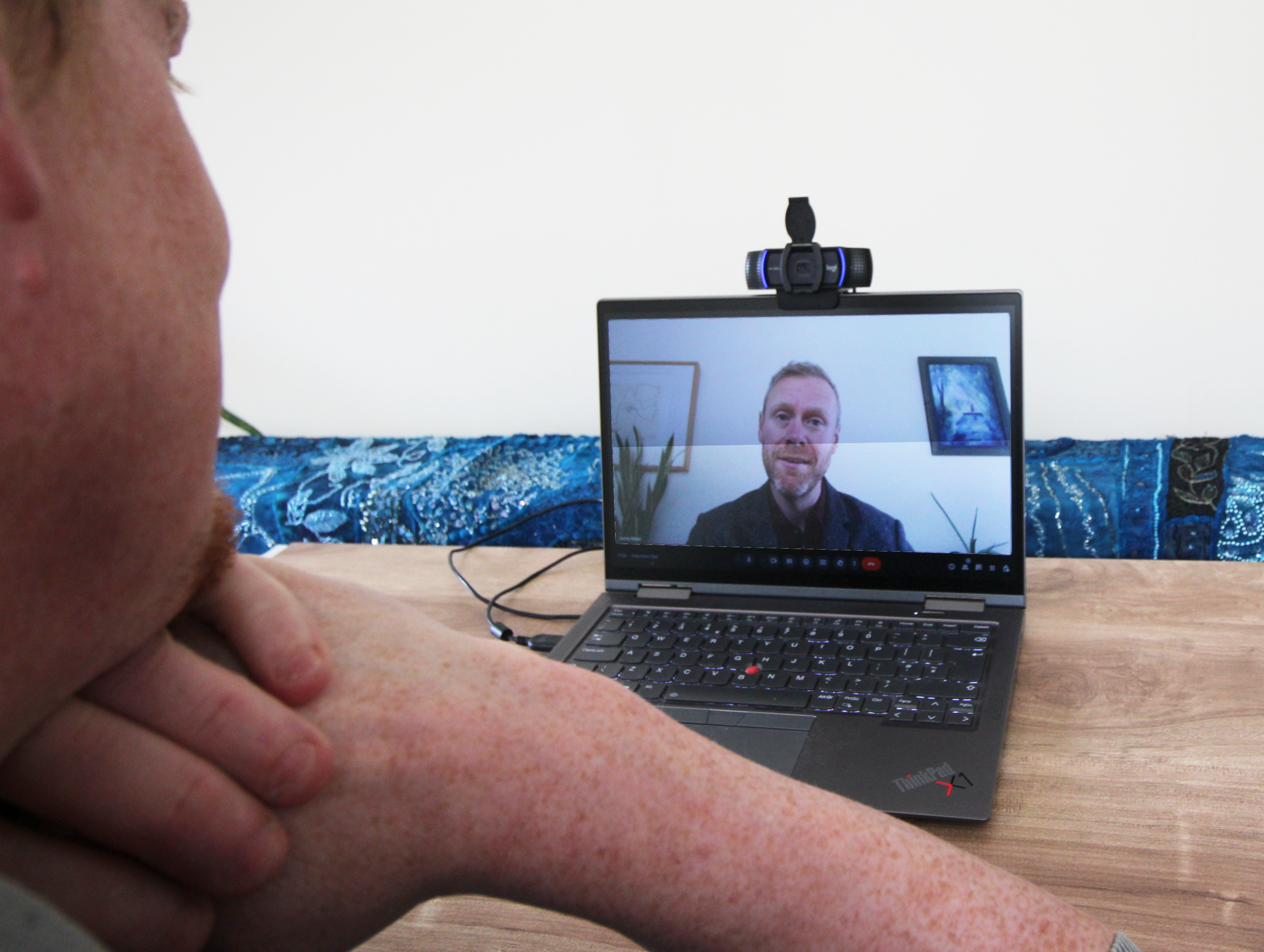
There isn’t one psychological approach that is suitable for every person experiencing existential anxiety or spiritual crisis.
This is one reason I use an integrative approach.
Different therapeutic models offer different ways of understanding what may be happening, and different tools may be useful at different stages.
Hypno-therapy
Hypnosis can provide an opportunity to slow down, focus attention and experiment with different ways of experiencing thoughts, emotions, bodily sensations and internal imagery.
A review of meta-analyses found evidence for beneficial effects of hypnosis across several mental and physical health applications, while also identifying considerable variation in the quality and scope of the evidence.
This is why I don’t see hypnosis as a magical solution.
Instead, it can be one component of a broader therapeutic process.
For some people, hypnotic work can make it easier to practise slowing down, observing experience and developing a different relationship with thoughts and sensations.
Exposure Therapy
Exposure-based approaches can be particularly relevant when anxiety is maintained by avoidance and attempts to control uncertainty.
Rather than continually trying to eliminate anxiety, carefully planned exposure can help you discover that you can remain present with experiences you previously felt compelled to escape, suppress or control.
For existential anxiety, this might sometimes involve gradually approaching thoughts about death, uncertainty, meaninglessness or loss of control.
This is paced so that you can engage with the experience, without becoming overwhelmed.
This can create new perspectives, relationships and opportunities for new insights.
Person-centred Therapy
Person-centred therapy places considerable emphasis on the therapeutic relationship, empathy, congruence and unconditional positive regard.
This can be particularly important when your identity is changing.
You don’t necessarily need another person to tell you who you are.
You may need a relationship in which you can safely explore what is happening without having to perform a particular identity.
This fits closely with the idea of belonging.
The therapeutic relationship can become a place where you experience:
“I don’t have to have this figured out before I can be here.”
Existential Therapy
Existential therapy is particularly relevant when anxiety is connected with questions of mortality, freedom, responsibility, meaning, isolation and identity.
Instead of treating these questions simply as irrational thoughts to eliminate, existential therapy can explore what they reveal about how you are living.
The aim isn’t necessarily to find the answer to life.
It can be to develop a more authentic relationship with the fact that some questions may remain open.
Transpersonal Therapy
Transpersonal approaches can provide a framework for exploring experiences that people understand as spiritual, mystical or transcendent.
This can be particularly relevant when someone feels that a conventional psychological explanation doesn’t fully capture their experience.
However, the evidence base for transpersonal therapy remains considerably less developed than that for established treatments such as CBT.
A systematic review of transpersonal psychotherapy and altered states identified few empirical studies (only 14), so there is a need for more research and clearer guidelines.
I therefore see transpersonal ideas as potentially useful frameworks for exploration, rather than as established explanations of what unusual experiences objectively mean. Indeed, in this kind of work, established explanations may not be as helpful as possibilities and tolerance of uncertainty.
Schema Therapy
Schema therapy can be useful when existential anxiety is connected with longstanding patterns involving abandonment, defectiveness, emotional deprivation, isolation, unrelenting standards or other deeply established ways of relating to yourself and others.
It can help distinguish between what is happening now and older patterns that may be influencing your interpretation of what is happening.
Research into schema therapy for anxiety-related conditions is relatively limited, but encouraging.
The therapeutic alliance
And beneath all of these approaches is something perhaps even more fundamental:
The relationship between therapist and client.
A substantial meta-analysis by Flückiger et al. (2018) examined 295 studies involving more than 30,000 participants.
They found a robust positive association between therapeutic alliance and treatment outcome across different therapeutic approaches, client characteristics and settings.
This doesn’t highlight the alliance as causation for improvement, rather, a robust condition for improvement.
But it does suggest that how you experience the therapeutic relationship matters.
Perhaps this is another form of belonging.
Not being told:
“Here is the answer.”
But experiencing:
“You don’t have to face this alone while you work out what this means for you.”
You Don’t Have to Get Rid of Predicty
Perhaps the goal isn’t to defeat Predicty.
After all, prediction is useful.
We need it to plan tomorrow, cross the road, prepare for an important conversation and recognise genuine danger.
Predicty can be your wingman.
The problem arises when the wingman starts running the whole operation.
Belongy can take the lead sometimes.
You can allow yourself to experience something before deciding what it means.
You can explore before deciding
…and notice before analysing.
You can breathe before solving.
You can belong before you understand.
And sometimes, remarkably, this allows Predicty to do its job better.
When you’re exploring something creatively, for example, you may not begin with the answer.
You follow your curiosity.
You notice something.
An association appears.
You follow that.
Another idea emerges.
Only later does the more analytical part of your mind organise what you’ve discovered.
Belongy leads. Predicty follows.
That can be a surprisingly productive partnership.
A Simple Belonging Practice

You don’t need to wait until you’re completely calm to practise this.
Try it for two minutes.
First, slow down.
Allow your breathing to become a little easier, without forcing it.
Then notice what is already happening.
Perhaps there is anxiety.
Perhaps there is calm.
There may be confusion,
…or perhaps there is nothing particularly noticeable.
Don’t search for a special experience.
Instead, notice whether there is even a tiny sense of being here.
You might notice your feet.
The chair beneath you.
The air against your skin.
A sound.
A breath.
A colour.
A feeling.
A thought.
You don’t have to make any of these things disappear,
…or make yourself feel safe.
You don’t have to understand what is happening.
Just notice:
“This is happening, and I am here.”
Perhaps there is a tiny sense of belonging.
If there is, let it be enough.
If there isn’t, that is okay too.
You can belong with that.
You can spend two minutes each day noticing these moments and writing down what you observed.
Over time, you may begin to recognise that belonging isn’t necessarily a dramatic emotional state.
It can be subtle.
It can coexist with anxiety
… as well as with uncertainty.
It can coexist with not knowing.
And perhaps that is part of its usefulness.
Belonging Doesn’t Require Certainty
Existential anxiety can make you want certainty about things that cannot ultimately be made certain.
Spiritual crisis can make you want an explanation for experiences that may remain ambiguous.
Identity change can make you want to know exactly who you are becoming.
But perhaps psychological flexibility doesn’t always come from answering every question.
Sometimes it comes from discovering that you can remain present while the question is still open.
You can belong in uncertainty.
You can belong in confusion
…as well as belonging without having a perfectly coherent identity.
You can belong while your beliefs are changing.
…and also while you are frightened.
You can belong while you are searching.
And perhaps, eventually, you discover something that Predicty couldn’t have predicted:
You didn’t have to solve your experience in order to be part of it.
If you are experiencing existential anxiety, death anxiety, a spiritual crisis or a profound period of uncertainty, online integrative hypno-therapy can provide a space to explore these experiences carefully and at your own pace.
The aim isn’t to tell you what your experience means.
It is to help you develop a relationship with it that gives you more freedom, choice and capacity to live alongside uncertainty.
Sometimes the first step isn’t finding the answer.
Sometimes it is discovering that you can belong while you are still asking the question.
FAQs
It can. A sense of belonging and connection is associated with better psychological wellbeing, while loneliness and social disconnection are associated with poorer mental-health outcomes. Belonging may also provide an alternative to constantly trying to resolve uncertainty through thinking, checking or seeking reassurance.
However, belonging isn’t a guaranteed treatment or a way of making existential questions disappear. It may be more helpful to think of it as developing a greater capacity to remain present and connected while uncertainty, anxiety or difficult questions are present.
For some people, uncertainty itself becomes associated with threat. When you don’t know what will happen, your mind may respond by trying harder to predict, analyse or control the situation.
This can produce a cycle in which anxiety leads to more searching for certainty, which provides temporary relief but leaves you less comfortable with uncertainty the next time it appears.
Therapeutic approaches such as exposure therapy can help you gradually discover that you can experience uncertainty without always needing to eliminate it or find an answer.
Yes. Some people report significant anxiety, confusion, changes in identity, altered perceptions, questions about meaning and purpose, or changes in their understanding of reality during experiences they describe as spiritual awakening or spiritual crisis.
However, unusual or overwhelming experiences should not automatically be assumed to be either a spiritual transformation or a mental-health disorder. Sometimes both psychological and spiritual perspectives may be relevant.
If you are encountering difficulty with everyday functioning, it is important to seek appropriate professional support.
Hypnotherapy may be helpful for some people as part of an integrative therapeutic approach. Hypnosis can provide a focused context in which you can explore thoughts, emotions, bodily sensations and habitual responses to anxiety.
For existential or death anxiety, however, the aim would not necessarily be to convince you that death is nothing to fear or to provide certainty about what happens after death. Instead, therapy may help you develop a different relationship with uncertainty, mortality and the feelings that arise when you think about them.
Hypnotherapy can therefore be combined with approaches such as existential therapy, person-centred therapy and appropriately paced exposure work, depending on your needs.
You can start very simply.
Slow down and notice what is already happening. Feel your feet against the floor, notice your breathing, listen to the sounds around you or become aware of the sensations of sitting in your chair.
You don’t need to make yourself calm.
No need to find a special spiritual experience.
You don’t even need to feel that you belong.
Instead, you can experiment with noticing:
“This is happening, and I am here.”
There may be a strong sense of belonging, or only a tiny sense of it. Either is enough to practise with.
With repetition, you may become more familiar with being present with uncertainty rather than automatically trying to solve, avoid or control it.